
The Diesel Particulate Filter (DPF) is an important part of a modern diesel vehicle’s exhaust and emissions system. It captures soot produced during combustion and periodically removes accumulated soot through a process known as DPF regeneration.
When the DPF system is unable to regenerate correctly, the vehicle may display a DPF warning light, engine warning light or develop reduced performance.
At Melbourne Euro, we diagnose, regenerate, clean and repair DPF systems across a wide range of European diesel vehicles.
What is a DPF?
A Diesel Particulate Filter (DPF) is installed within the exhaust system to capture and store soot particles before they leave the vehicle through the exhaust.
Over time, soot accumulates inside the filter and needs to be removed through regeneration.
While soot can be burned during regeneration, ash cannot be burned away in the same way and can gradually accumulate over the life of the DPF.
How Does a DPF Work?
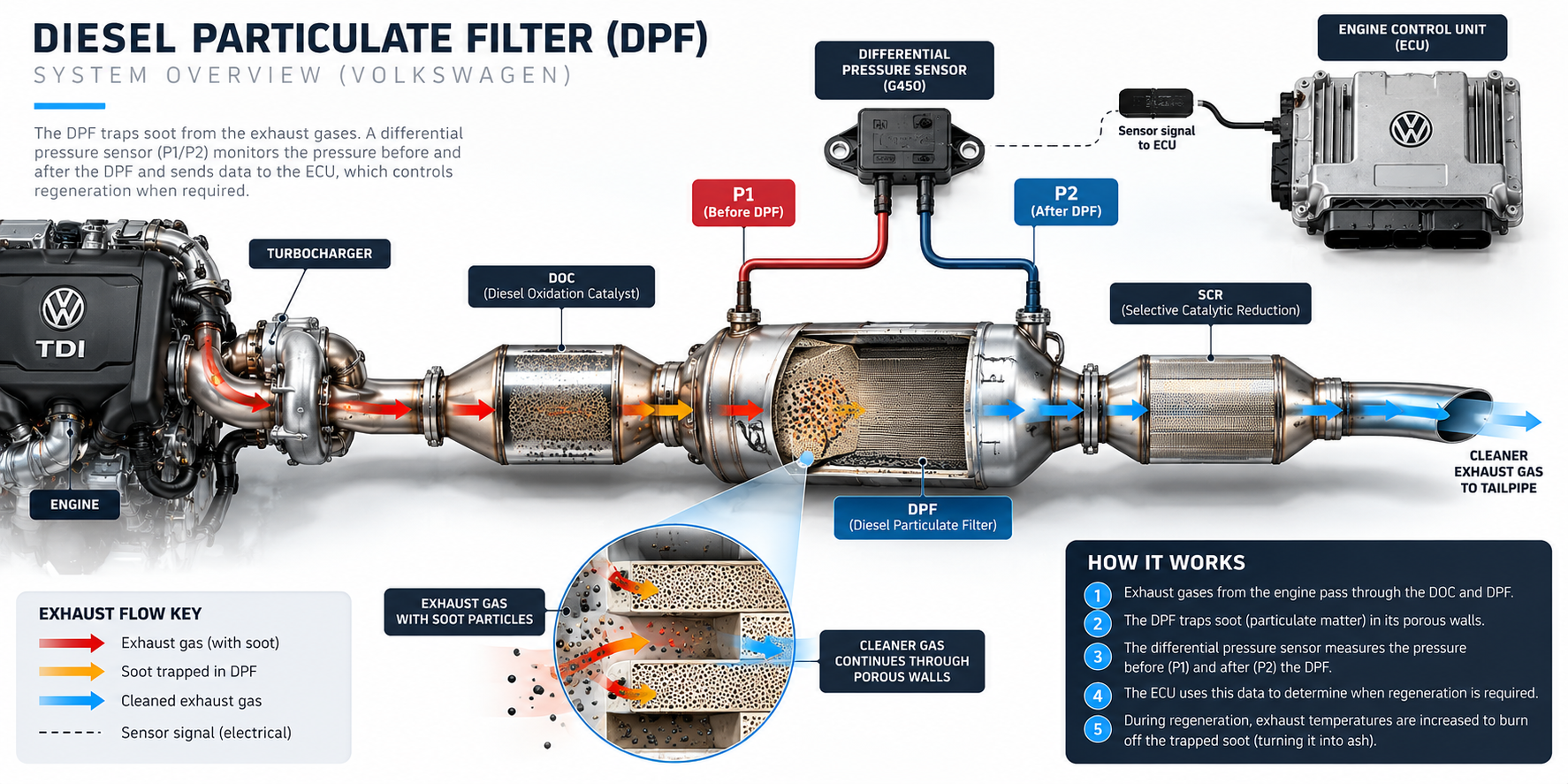
Exhaust gases leaving the engine pass through the DPF, where soot particles are trapped within the filter structure while the cleaned exhaust gases continue through the exhaust system.
ENGINE → EXHAUST → DPF → CLEANED EXHAUST
The vehicle’s ECU monitors the DPF using several sensors and calculated values.
A key component is the DPF differential pressure sensor, which compares exhaust pressure before and after the DPF.
Before DPF (P1) → DPF → After DPF (P2)
P1 + P2 → Differential Pressure Sensor → ECU
As soot builds up and exhaust flow becomes more restricted, the pressure difference across the DPF generally increases. The ECU uses this information together with exhaust temperature, engine load and other data to monitor DPF operation and determine when regeneration is required.
What Are the Common DPF Problems?
DPF problems are not always caused by the filter itself.
Common faults can include:
- Excessive soot accumulation
- Ash accumulation
- Failed or interrupted regeneration
- Faulty DPF differential pressure sensor
- Blocked, split or leaking pressure sensor hoses
- Exhaust temperature sensor faults
- EGR or engine-related faults causing excessive soot
- Short-distance driving preventing normal regeneration
DPF Pressure Sensor Faults
The differential pressure sensor allows the ECU to monitor the pressure difference across the DPF.
If the sensor, pressure pipes or electrical circuit develops a fault, the ECU may receive an incorrect pressure reading even when the DPF itself is not blocked.
Common DPF pressure sensor fault codes include:
P2452 – DPF Pressure Sensor Circuit
P2453 – DPF Pressure Sensor Range/Performance
P2454 – DPF Pressure Sensor Circuit Low
P2455 – DPF Pressure Sensor Circuit High
P226D – Damaged or substrate missing.
A pressure sensor fault code does not automatically mean the DPF needs replacing. The sensor, pressure lines, wiring and actual DPF restriction should be checked first.
The DPF Warning Light
The DPF warning light generally indicates that the vehicle has detected excessive soot loading or that normal regeneration has not been completed successfully.
In some cases, suitable driving conditions may allow the vehicle to complete a normal regeneration.
If the warning remains illuminated, returns frequently, or is accompanied by an engine warning light, glow plug light or reduced power, further diagnosis may be required.
Ignoring the problem can allow soot loading and exhaust restriction to continue increasing.
Melbourne Euro DPF Solutions
There isn’t one solution for every DPF problem. At Melbourne Euro, we first diagnose the system to determine why the DPF warning or restriction has occurred before deciding on the appropriate repair.
OPTION 1 – DPF Regeneration Using Diagnostic Software
Where the DPF condition and soot loading allow it, we can perform a controlled DPF regeneration using professional diagnostic software.
The vehicle is monitored during the process to confirm regeneration conditions, exhaust temperatures and DPF data.
This can be suitable when normal regeneration has been interrupted or has not occurred because of the vehicle’s operating conditions.
OPTION 2 – DPF Cleaning with material + Regeneration
For DPFs with greater soot accumulation, additional cleaning may be required before regeneration.
Depending on the condition of the system, this can involve the use of professional DPF cleaning material, followed by a diagnostic regeneration or suitable extended drive to complete the regeneration process.
Before carrying this out, related faults such as pressure sensor, temperature sensor or engine-management problems should be addressed.
OPTION 3 -Track-Only or DPF Replacement Options
Where a DPF is physically damaged, excessively ash-loaded or no longer serviceable, DPF replacement may be required. For vehicles used exclusively in permitted off-road or track applications, other options may be available depending on the vehicle and intended use.
Melbourne Euro can inspect the system and recommend the appropriate option based on the DPF’s condition and the vehicle’s application.
Frequently Asked Questions
Can a blocked DPF be regenerated?
Sometimes. If the DPF is within an acceptable soot-loading range and there are no faults preventing regeneration, a diagnostic regeneration may restore normal operation. More severe contamination may require cleaning or replacement.
Does a DPF warning light mean the DPF needs replacing?
No. The warning can be caused by soot accumulation, failed regeneration, sensor faults or other engine and emissions-system problems. Diagnosis should be carried out before replacing the DPF.
What does the DPF pressure sensor do?
It measures the difference in exhaust pressure before and after the DPF. The ECU uses this information to help determine the level of restriction through the filter.
Can a DPF pressure sensor cause a DPF warning light?
Yes. A faulty sensor, blocked pressure pipe, damaged hose or electrical problem can produce incorrect pressure information and contribute to DPF-related warning lights or fault codes.
Why does my DPF keep blocking?
Repeated DPF problems can be caused by short-distance driving, unsuccessful regeneration or underlying engine faults that produce excessive soot. The cause should be diagnosed rather than repeatedly regenerating the DPF.
Can Melbourne Euro perform a DPF regeneration?
Yes. Melbourne Euro can diagnose DPF faults and, where appropriate, perform controlled regeneration using professional diagnostic equipment.
Can a DPF be cleaned instead of replaced?
Depending on its condition. A soot-loaded DPF may sometimes be cleaned and regenerated. A physically damaged or excessively ash-loaded DPF may require replacement.